About this article
Panorama was one of Italy's two leading weekly newsmagazines in 2000, alongside L'Espresso. Published by Mondadori, it had national circulation in the hundreds of thousands and shaped business and political conversation across the country. The economy section ran extensive coverage of the dot-com era and the new generation of Italian internet entrepreneurs.
This profile, written by veteran economic journalist Marco Cobianchi, appeared in the November 2000 issue: just months before the bursting of the internet bubble that would reshape the entire sector. It captured a specific moment in time, when consolidation, not raw growth, was beginning to be recognised as the path forward for Italy's fragmented internet provider market.
What the article covered
The article focused on a strategic project then taking shape in Italy: the consolidation of dozens of independent Internet Service Providers (ISPs) operating at regional level, scattered across the country, each serving local business and residential customers. While the major Italian telecommunications groups, Telecom Italia, Wind, Infostrada, were racing to capture national market share, a parallel movement was emerging from the bottom: small, agile providers banding together to negotiate from strength against the giants.
At the centre of this project was Club Nautilus, founded and led by Gianluca Leotta, a young entrepreneur in his mid-twenties from southern Italy. The article presented Leotta as someone who saw what others did not yet see: that the future of Italian internet services would belong neither to the biggest national players alone, nor to the most innovative individual startups, but to whoever could build a federation of mid-sized operators with combined scale and local depth.
Panorama described the deal-making approach used to bring together what eventually became a network of nineteen Internet Service Providers across northern and central Italy. The piece detailed the financial structuring behind the acquisitions, the role of venture capital partners (notably the Kiwi II fund and the eNutrix incubator), and the explicit ambition: to reach a critical mass capable of competing with the national telecommunications incumbents on price, service quality, and breadth of offering.
The article also highlighted the generational dimension: a southern Italian entrepreneur, just out of university, executing a sophisticated build-up strategy in a sector dominated by established corporate interests. It positioned Leotta among the figures shaping what the magazine called the Italian "new economy", a definition that would soon be tested by the market crash of 2001.
Why it matters today
Read twenty-six years later, this article marks the public starting point of a recurring theme in Gianluca Leotta's career: creating value by aggregating what is fragmented. The same approach that drove the ISP consolidation in 2000-2002 would reappear, in different forms, across his work as a business lawyer (the conception of the Italian "Fondo Valorizzazione Imprese" scheme with ABI and the Italian banking system in 2013), as a publishing author (contributions to national references on M&A and corporate restructuring), and as an investor (the 2012 acquisition of Audiencerate, the UK Audience Data Management company that joined the Microsoft partner ecosystem in 2024 and obtained Google Customer Match Partner status in 2025).
The 2001 internet bubble would shortly close the first chapter of this story. But the underlying conviction, that fragmentation is an opportunity, and that consolidation requires both legal craft and entrepreneurial vision, has shaped the work that followed.
Original clipping
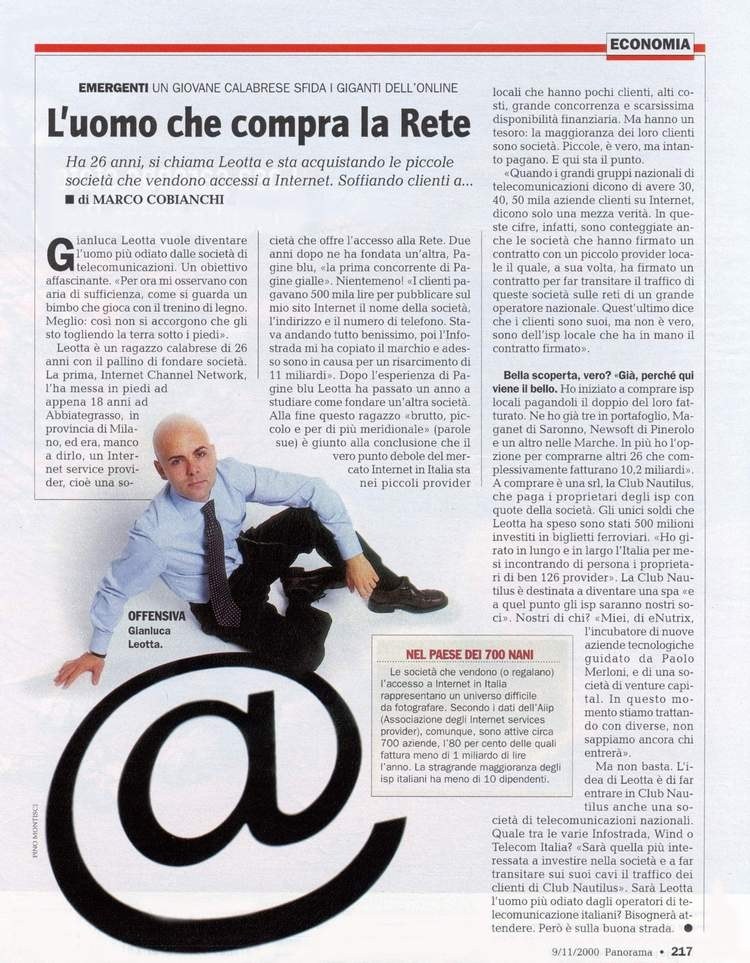
Click to enlarge. From the Panorama archive, November 2000 issue.